Be yourself; Everyone else is already taken.
— Oscar Wilde.
This is the first post on my new blog. I’m just getting this new blog going, so stay tuned for more. Subscribe below to get notified when I post new updates.
Be yourself; Everyone else is already taken.
— Oscar Wilde.
This is the first post on my new blog. I’m just getting this new blog going, so stay tuned for more. Subscribe below to get notified when I post new updates.
Water is the most important aspect of dairy farming; how it gets to the dairy, who says how it is used, and how it is treated. There are many regulations, laws, and cultural norms that govern the use of water, but there is more to water than the amount used. The quality of water and how it is treated is also important. If a cow has an organic diet, but is being pumped with chemically treated water, or water that is filthy, what is the purpose of organic dairy farming?
When someone looks to buy land for a dairy, “The most outstanding aspect to any plot of land is access to water” (Lie-Nielsen pg.47). Back East, it may be easy to find a stream, pond, or other source of water. In the West, it usually relies on man made source, for example, the Hoover dam when built was expecting to serve “seven Basin states” (Kwak, 2014). So, considering the source is important. Wells are expensive to have drilled but cheap to keep, canals are usually seasonally restricted, and city water is also expensive but consistent.
Understanding who governs your water is important especially during a drought. Understanding the laws of the land can prevent you from getting into trouble and losing your investment. Water laws are revised often, so get involved, and get to know your neighbor because in Utah “the first landowner to beneficially use or divert water from a groundwater source is given priority over later users” (NACL 2019). Meaning if your source of water flows through a more senior landowner than yours and there is a drought, they can legally take all the water.
This paragraph is more for the consumer of milk. Records show that even 2,000 years ago there is written proof that “‘impure water should be purified by being boiled over a fire, or being heated in the sun, or by dipping a heated iron into it, or it may be purified by filtration through sand and coarse gravel and then allowed to cool’ […] ‘It is good to keep water in copper vessels, to expose it to sunlight, and filter through charcoal” (Angelakis pg.23), so obviously water is being treated today, and If you are spending extra money on organic milk, understanding where the cows producing your milk are getting their water is important. There are chemicals out to help reduce bacteria, fungus, scale, etc. that may be going into your cows water. Much of the organic requirements for dairy cows focuses on food and shots, but there is little to be said about the water.
This is important because the decisions made now affect us and the generations to come. If water sources and treatment are not considered, they may get out of hand, and with water being the most essential substance for all life (after the sun), it is important to protect. To act on this, I will be more careful about my milk source, so I know what water is making up my dairy source.
Sources:
Angelakis, Andreas N, et al. Evolution of Water Supply through the Millenia. IWA Publishing, 2012. https://iwaponline.com/ebooks/book/472/Evolution-of-Water-Supply-Through-the-Millennia
Kwak, Young Hoon, et al. “What We can Learn from the Hoover Dam Project That Influenced Modern Project Management?” Elsevier, vol. 32, no. 2, Feb. 2014, pp. 256–264., https://www.sciencedirect.com/science/article/pii/S0263786313000422?via=ihub.
Lie-Nielsen, Kirsten. So You Want to Be a Modern Homesteader?: All the Dirt on Living the Good Life. New Society Publishers, 2019.
HB0039, le.utah.gov/~2020/bills/static/HB0039.html#73-10g-202. https://nationalaglawcenter.org/overview/water-law/
With each state having its own say for the most part, it becomes difficult to write for all the western states, and therefore I will be focusing on Utah since it is a western state that is not extremely North or South. Allocating water handles who gets the water first, last, how much water, etc. Also it deals with what the water source is. Is it on the surface, or is it groundwater (aquifer). Utah for example follows the Prior Appropriation law for water, which means “the first landowner to beneficially use or divert water from a groundwater source is given priority over later users” (NACL 2019).
In Utah, the legislation comes from the Utah Division of Water Rights who work along with the Natural Resource Conservation Service to make sure what is best for human rights is good for the land. As for who the director is, on February 13, 2020 Teresa Wilhelmsen was sworn in as the state engineer and director of the Utah Division of Water Rights.
With the importance of water and a progressive government, there are constant changes going on, one example in Utah is recent amendments to house bill 0039. One of the amendments to the bill is that a minimum of “three individuals whose primary source of income comes from the production of agricultural commodities” (HB0039 line 38-39), must be apart of the Agricultural Water Optimization Task Force, this to protect those in agriculture who handle hands on situations and can voice from experience and knowledge.
Water is a sensitive subject, and giving voice to the public, farmers, and politicians is important. Without the view of multiple perspectives, subjects can become thwarted. We all use, share, and deposit water, it is an important resource especially in deserts where there is little.
Resources:
HB0039, le.utah.gov/~2020/bills/static/HB0039.html#73-10g-202.
Water Law Overview
Through all civilizations, water has been the foundation. The earliest recording of controlling water flow is “About 6000 to 7000 years ago” (Angelakis, pg.19), no wonder why “water witching” (water divining or dowsing) is a common topic; it is a life or death situation. Usually food can be created or found as long as the water source is present.
Water witching (divining or dowsing) is using “a forked stick, rod, or pendulum to locate underground water” (deming pg.450). This began thousands of years ago, but has not been taught in formal education and no one really knows where it originates from. Some people reference the story of Moses in Numbers 20:11, “And Moses lifted up his hand, and with his rod he smote the rock twice: and the water came out abundantly, and the congregation drank, and their beasts also”. Although water witching usually requires digging a well, it seems to be a similar idea. In Europe it is claimed that “German miners were imported into England during the reign of Queen Elizabeth, and brought the practice… with them”(deming pg.450).
Years ago, water was the foundation of civilization, those civilizations still present and usually the large cities. Now as humanity spreads across the land, water is more of a marketable value; this is why the “price per-acre, was much less than the going rate” said Jim Hackard (Kinkead pg.260). One example of modern day water witching is Jim Hackard. When people found out Jim had a talent, they would have him help them find water, one of them a physician who “gave [him] a case of wine” (Kinkead pg.261) as a thank you since Jim would not accept payment. Although Jim did not want water dowsing to work, people were grateful for his ability and it always worked.
This research has helped me to understand more in depth how important water is, especially for farmers in the west where water sources more often than not are below the surface. Much of the west is arid and relies on underground water to survive. The importance of water can never be overestimated, especially when striving to keep dairy cows hydrated, when they drink roughly 40 gallons per day. Water is the foundation of life.
Works Cited:
Angelakis, Andreas N. “Evolution of Water Supply Through the Millennia.” Water Intelligence Online, vol. 11, Apr. 2012, doi:10.2166/9781780401041.
Deming, David. “Water Witching and Dowsing1.” National Groundwater Association, John Wiley & Sons, Ltd, 13 Dec. 2005, ngwa.onlinelibrary.wiley.com/doi/epdf/10.1111/j.1745-6584.2002.tb02525.x.
Kinkead, Joyce A., et al. Farm: a Multimodal Reader. Fountainhead Press, 2016. (pg 260-262)
At first glance, when water comes out of the faucet it seems like a simple act that most are used to. But when traced back from where it originates, especially in the west; there will be miles of pipes, multiple pumps, and a location probably distant from you where the water source is. If you have your own water source such as a well, it still for convenience requires pipes, electric pumps and a machine or man that previously dug that well. But focusing on the majority, this distant place is usually called a reservoir. In the west almost all water is supplied from reservoirs, much electricity is supplied through hydroelectric generators, and they also control flooding which keeps a constant flow year round. To help understand the importance, and the work that these reservoirs require, a study of the Hoover Dam is appropriate.
Reservoirs require damming, some man made and others natural. The Hoover Dam has been around since the mid 1900’s and is still viable. This is why “Preliminary designs were prepared from over a period of ten years” (Dunar and Mcbride, 1993). Once plans were solidified, “pre-construction activities” had to take place prior to actual work on the dam, “including work on building Boulder City to accommodate construction workers, on the railroad spur linking Las Vegas and Black Canyon, to access the site, as well as the communication line” (Kwak, 2014).
A project of this size takes money, a company that merged 6 companies as one gave the lowest bid which was “significantly less than their competition, at $48,890,955” (Kwak, 2014). Seems like a lot of money, but this reservoir was expected to serve “seven Basin states” (Kwak, 2014) including “Arizona, California, Colorado, Nevada, New Mexico, Utah, and Wyoming” (Kwak, 2014), and it lead to “the greatest leap forward in concrete technology ever” (Dolen, 2010). That almost 49 million dollar bid has gone a long way.
Now the focus of this article, how much manpower did the Hoover Dam require? That is hard to estimate while thinking about engineers, politicians, and others involved in the preparation, the ongoing project, and the follow up that lasted over 15 years. Just in construction, the “Hoover Dam project, employ[ed] approximately 5200 people at its peak” (Kwak, 2014). How many came before and after is hard to say, but with “On site deaths … estimated at more than 1000 workers, not including those documented as victims of pneumonia” (Smith, 2011), and “Although workers were well compensated and received housing benefits, it has been well documented that many workers died of carbon monoxide poisoning in tunnels with inadequate ventilation” (Rogers, 2010).Considering these facts and that people are still employed today by the dam, it is a significant chunk.
Sources:
Dolen, Timothy P. “Advances in Mass Concrete Technology-The Hoover Dam Studies.” Hoover Dam, 2010, doi:10.1061/41141(390)5.
Dunar, Andrew J., and Dennis McBride. Building Hoover Dam: An Oral History of the Great Depression. University of Nevada Press, 2016.
Kwak, Young Hoon, et al. “What We an Learn from the Hoover Dam Project That Influenced Modern Project Management?” Elsevier, vol. 32, no. 2, Feb. 2014, pp. 256–264., https://www.sciencedirect.com/science/article/pii/S0263786313000422?via=ihub.
Rogers, J. David. “Hoover Dam: construction milestones in concrete delivery and placement, steel fabrication, and job site safety.” Hoover Dam: 75th Anniversary History Symposium. 2010.
Smith, Nick. “Classic projects.” Engineering & technology 6.1 (2011): 112-113.
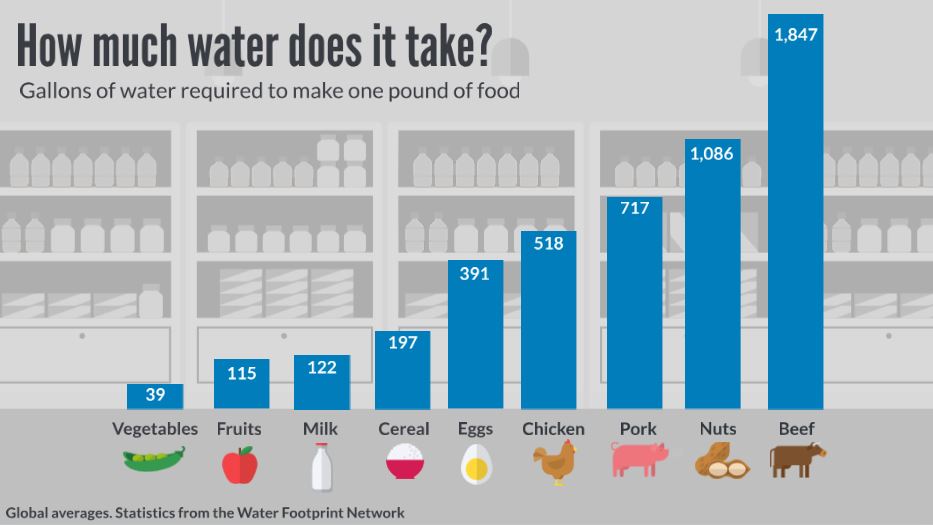
This image is found on Denver Water Tap from an article that is encouraging people to be mindful of what they consume with water in mind. This image comes from a trusted source, does well at drawing attention to its message, and keeping it simple so that it seems logical. It does at the same time leave out other information that could challenge the logic, and it is coming from a bias source.
Colorado is high mountain desert and therefore has low water inputs, so high outputs will quickly put a strain on fresh water sources. Kristin is a communication specialist and Denver Water is using her as a strength to get the word out to the public. The message is to encourage people to eat less animal products especially beef, eat more produce, and waste less food. This image was created by a global non-profit organization whose “mission is to use the water footprint concept to promote the transition toward sustainable, fair, and efficient use of fresh water resources worldwide”(Water Footprint Network). They are trying to change how water is used and treated, so as a whole we all have fresh water to share. A big concern is the rate water is consumed and the increase in population. This graph gives a clear image of what takes majority of the water we consume in diet. Diet being the emphasis; there are many other graphs of how water is being used or conserved, but simple is best when getting a point across.
The image uses color to draw on emotions and subconscious connections to the image. The gray grocery store in the back ground sets the stage in a subtle manner which allows the black letters to pop. Then Blue is used because it contrasts well and it connects the graph to water. The objects or topics being contrasted are colored in bright and distinct colors for each topic, so they are easily distinguishable for any age.
There is currently a push for sustainability and this image is a way of allowing children access to information and for adults it can be a reminder, quick information, or a step to look more into water use. The message is clear and would not be questioned by most, due to our natural understanding, but Constant reminders are needed, especially when convenience is involved.
Denver Water is trying to get a point across that water is required for our diet, so be mindful of what you eat and waste to conserve fresh water. They are in a position of trust and they do have bias, so looking into the content behind the image helps to learn where the info is coming from and if it is authentic.
Sources:
Delynko, Kristi. “What’s the Beef with Water?” News on TAP, Denver Water, 25 Feb. 2019, denverwatertap.org/2019/02/14/whats-the-beef-with-water/.
Fabrique [merken, design & interactie]. “Multimedia Hub.” Multimedia Hub, waterfootprint.org/en/resources/multi-media/.
A dairy cow is made up of “60-70% water” (Micheal L. Looper 2002) and takes in “18 to 36 gallons” (Micheal L. Looper 2002) per day depending on temperature and milk production stage. With water being this important, it is easy to see why farmers would want water easily accessible.
The idea of a water trough did not start with dairy cows, but they are a large reason why troughs are still around today. A water trough is a tool used by most modern day farmers; that allows easier access to water for animals. Although water troughs only began being implemented in cities in the early 1900’s, water had been redirected to areas that were not natural long before. As people began gathering and raising live stock, water was not always conveniently located; and therefore they began redirecting water for convenience. A great example of this is: Annis and George bills; who recognized a need for horses in cities. These horses were the main mode of transportation, and therefore it was important to care for them. Annis and George were generous when it came to caring for animals and so when they passed, their “Estate made provision for a Trust to erect drinking troughs for animals wherever the Executors thought appropriate;” (Margaret McWilliam 1983) this donation funded about “700 trouphs” (Margaret McWilliam 1983).
Now days, water is fairly accessible and most livestock and horses are kept on farms where troughs are utilized daily. These troughs are convenient, and with that comes a cost of maintaining them. After many years, farmers have found that “emptying and scrubbing troughs is effective, although arduous” (Clair Thunes 2017), this is the ‘elbow grease’ tactic that keeps dairy farmers busy especially in the summer when it is recommended at least once a week. Why is this important? Because farmers making a living off selling dairy products of which are crucial to our well being; need healthy dairy cows whose well being depends on water. That water if not cleaned will develop algae, scale, bacteria, etc…, all of which can harm them and some of which can harm us. So, if that water does not look, taste, smell, or feel (electricity) appealing, cows will not drink. Which we should be grateful for, because we are consuming what they are producing.
References:
Looper, M. (2002). ‘Water for Dairy Cattle’, Retrieved January 31, 2020, from https://aces.nmsu.edu/pubs/_d/D107.pdf
McWilliam, M. (1983). ‘History of the George and Annis Bills Horse Troughs’, together with research notes, ca. 1983. Retrieved January 31, 2020, from http://archival.sl.nsw.gov.au/Details/archive/110313281
Thunes, C. (2019, July 2). Algae in Horse Water Troughs: Is It Safe? Retrieved January 31, 2020, from https://thehorse.com/110425/algae-in-horse-water-troughs-is-it-safe/
This is an example post, originally published as part of Blogging University. Enroll in one of our ten programs, and start your blog right.
You’re going to publish a post today. Don’t worry about how your blog looks. Don’t worry if you haven’t given it a name yet, or you’re feeling overwhelmed. Just click the “New Post” button, and tell us why you’re here.
Why do this?
The post can be short or long, a personal intro to your life or a bloggy mission statement, a manifesto for the future or a simple outline of your the types of things you hope to publish.
To help you get started, here are a few questions:
You’re not locked into any of this; one of the wonderful things about blogs is how they constantly evolve as we learn, grow, and interact with one another — but it’s good to know where and why you started, and articulating your goals may just give you a few other post ideas.
Can’t think how to get started? Just write the first thing that pops into your head. Anne Lamott, author of a book on writing we love, says that you need to give yourself permission to write a “crappy first draft”. Anne makes a great point — just start writing, and worry about editing it later.
When you’re ready to publish, give your post three to five tags that describe your blog’s focus — writing, photography, fiction, parenting, food, cars, movies, sports, whatever. These tags will help others who care about your topics find you in the Reader. Make sure one of the tags is “zerotohero,” so other new bloggers can find you, too.

 Cows: Quality of their 70%